Business
Is a Bird-Friendly Building Ordinance Back on the Table? City Council Hearing Reignites Debate
Six months after Chicago’s updated Sustainable Development Policy went into effect, city officials have declared the revised guidelines a success in promoting bird-friendly building design while wildlife advocates call it a failure.
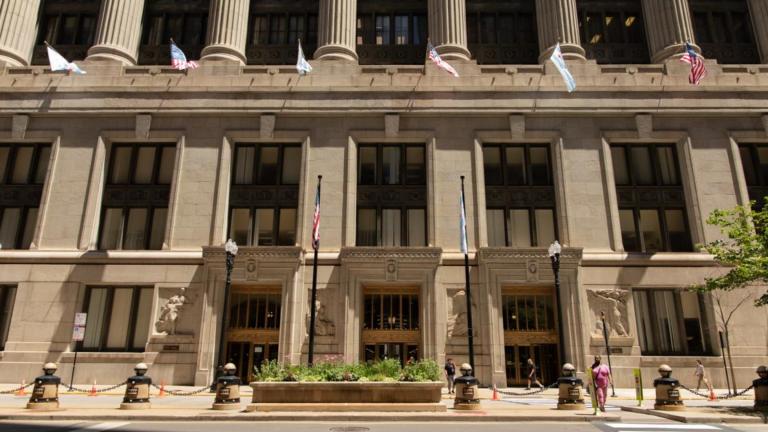
Representatives on both sides of the debate appeared Wednesday at a subject matter hearing in front of Chicago City Council’s Committee on Environmental Protection and Energy, chaired by Ald. Maria Hadden (49th Ward), with the aim of revisiting whether Chicago is doing enough to minimize bird collisions with buildings.
Elaine Carlson, a volunteer with Chicago Bird Collision Monitors, was firmly in the “no” camp. She was among the public speakers who urged committee members to do more for birds, namely by introducing an ordinance that would mandate bird-friendly design.
As she makes her rounds downtown picking up dead birds and rescuing the injured, Carlson said passers-by — residents, commuters and tourists alike — all ask the same question: “How can we let this happen?”
“And I have to apologize,” she said. “We know how to solve this, and for some reason we just haven’t.”
A Matter of Life or Death
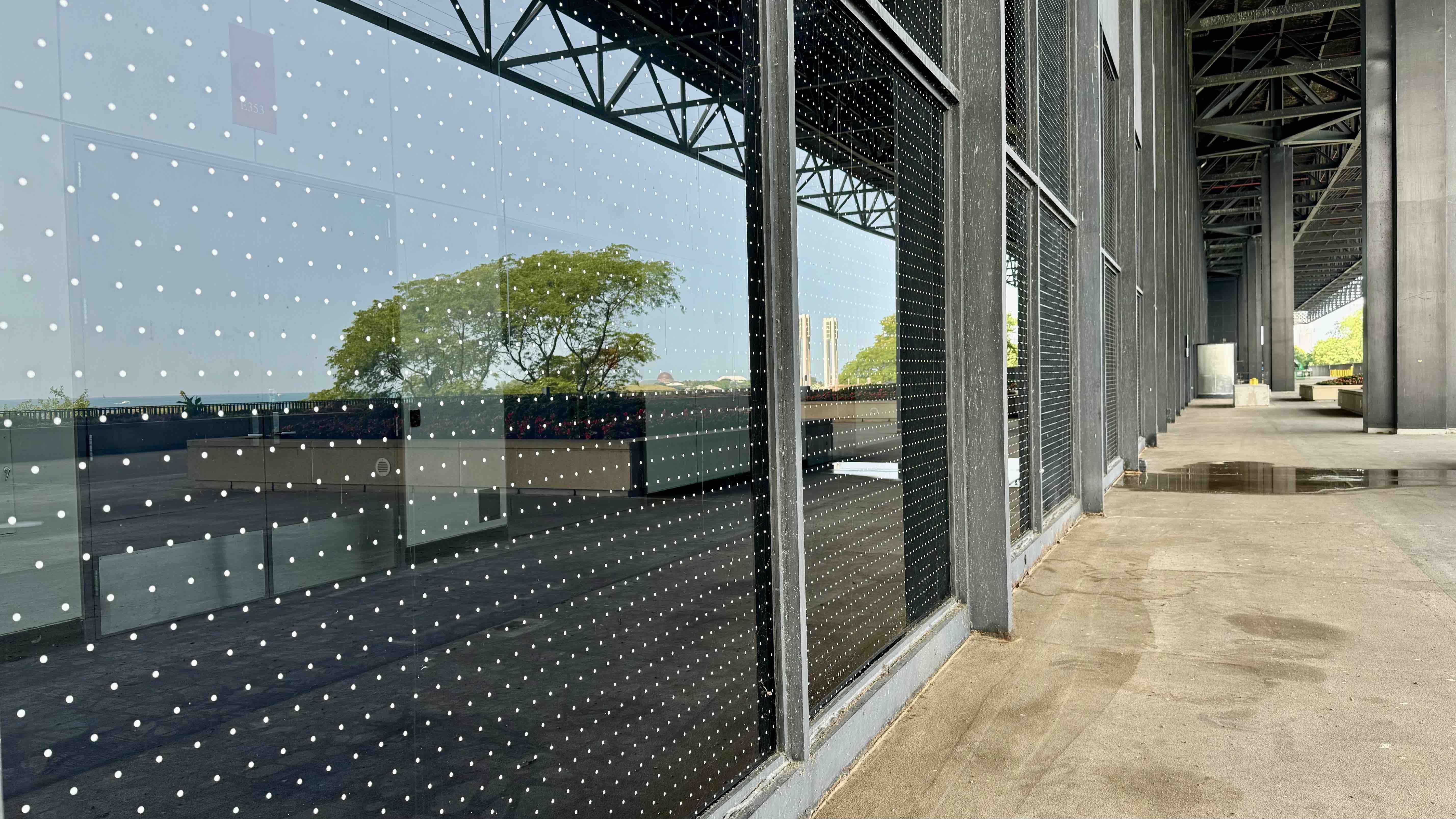 Since the retrofit of bird-friendly film on the windows, bird deaths at McCormick Place Lakeside have fallen 95%, proof that mitigations work, advocates said. (Patty Wetli / WTTW News)
More than 100 million birds migrate through Chicago every spring and fall as they head north to breeding grounds or south for the winter. Thousands of them never make it to their destination, killed by collisions with transparent or reflective window glass that the birds don’t perceive as an obstacle.
In 2020, instead of passing bird-friendly legislation — which cities including New York, San Francisco and Toronto have done — the City Council punted the issue to the Department of Planning and Development, instructing the department to give greater weight to bird-friendly mitigations within the Sustainable Development Policy.
Roughly 50 to 75 projects per year are subject to targets set by the Sustainable Development Policy, Bradley Roback, coordinator of economic development in the Department of Planning and Development, explained during Wednesday’s hearing.
Developers choose from a menu of options to reach specific point totals, and since the beginning of 2025, when the updated policy took effect, approximately half of the developments under consideration have selected bird-friendly design elements, Roback said.
That’s an increase, he said, from the approximately 10% of projects that previously incorporated bird-friendly aspects.
“The policy has been working,” Roback said. “More buildings than ever are choosing bird-friendly design elements.”
Advocates for mandated bird-friendly requirements said the impact, in the context of the total amount of construction taking place in Chicago, is minimal, affecting only a few dozen projects.
Would it be acceptable for fire safety regulations to only target 10% of buildings, or 50% or even 90%? asked Annette Prince, director of Chicago Bird Collision Monitors.
Meanwhile, “dangerous new buildings” continue to rise throughout the city without any review, Prince said.
“The level of death and injury is unacceptable,” she said. “We are asking for mandated measures that will determine whether something lives or dies.”
Economic Boom or Bust?
Opponents of a bird-friendly ordinance contend it would stunt economic growth by piling on regulations and red tape, and would make it prohibitively expensive to build anything in Chicago.
Bird-friendly glass — manufactured with patterns or glazes that birds can see — is one of the primary means of reducing collisions. Roback said he’s heard concerns from developers and designers about the availability of bird-friendly glass, as well as assertions that bird-friendly modifications can double the cost of glass.
Those figures were disputed by Charlie Rizzo and Mark Toth, founder and sales director of Skyline Design, respectively.
Skyline, based in Humboldt Park, has been in the glass manufacturing business for decades, and got into making bird-safe glass 10 years ago, Rizzo said. Among its most notable projects was creating a customized bird-friendly glass pattern for a building designed by award-winning architect Jeanne Gang.
Depending on the technique used, bird-safe markings add 3-10% to the cost of the glass, said Toth, and the glass itself represents only a fraction of a project’s budget.
Toth cited a $6 million renovation of Northwestern University’s Jacobs Center, where bird-safe glazing is a $75,000 line item. Google’s new headquarters has a projected cost of $250-$280 million, of which $500,000 is earmarked for bird-safe glass, representing .17% of the overall budget, according to Toth.
Adding bird-friendly elements after the fact can be pricier, Rizzo conceded.
If an ordinance were to include a requirement to retrofit existing glass, building owners would struggle to absorb the financial hit, said Amy Masters, director of government and external affairs for the Building Owners and Managers Association of Chicago (BOMA/Chicago), the trade association that represents Chicago’s office building industry.
BOMA has been a longstanding ally of bird advocates, Masters said, pioneering the Lights Out program, in which buildings go dark at night during spring and fall migration.
But with downtown vacancies at 29%, now is not the time to sock Chicago’s building owners with potentially millions of dollars in retrofits, Masters said, and she asked the committee to weigh this factor when crafting any potential ordinance.
Bird advocates said there’s another economic impact to consider: the money birders pump into the city’s coffers.
The U.S. Fish and Wildlife Service has pegged the nation’s birding economy at $280 billion, according to Bryan Lenz, glass collisions program manager at the American Bird Conservancy.
“Birders travel and they spend money,” Lenz said, with Chicago’s Montrose Point a top destination.
A Path Forward?
When Reuben Keller joined the faculty at Loyola University Chicago in 2011, he immediately noticed the number of dead birds on campus.
“Loyola has some really great architecture — covered in glass,” Keller, a professor in the School of Environmental Sustainability, told the committee.
Glass, along with the university’s lakefront location, made for a particularly deadly combination, which Keller and his students documented in daily rounds, picking up avian victims. They identified the buildings contributing to most of the collisions — as many as 15 to 20 birds a day at some sites — and worked with the administration to develop solutions.
At the Information Commons Building — one of the deadliest — the answer proved as simple as closing the programmable blinds at night during migration seasons. Other buildings were retrofitted with decals or window film and lighting was adjusted.
For an older building, which had manual blinds, Keller said his team worked with the janitorial crew, educating them about the problem of bird collisions and getting them to close the blinds by hand at night.
Today, Keller said, his bird collision group is all but “out of business,” with bird strikes down to nearly zero thanks to mitigations, and he credited the university for institutionalizing bird safety into new construction.
“It’s really cool to be doing this local conservation that has an impact across America,” he said.
It’s a model Hadden said City Council could look to as it mulls over next steps. There are multiple ways to make glass safer that aren’t “nearly as expensive as developers have made it out to be” and there are options besides glass, including better facilities management such as simply lowering window blinds or shades.
Ultimately, she said, the city has a responsibility to provide safe passage for the millions of birds who pass through during migration and those that call Chicago home.
It’s a point Prince has been making for years.
Deaths from building collisions are horrible, needless and, perhaps most importantly, preventable, Prince said.
“Will Chicago continue to be a place where birds come to die?” she asked.
Note: This article was published July 23, 2025, and updated with video July 24, 2025.
Contact Patty Wetli: @pattywetli | (773) 509-5623 | [email protected]